

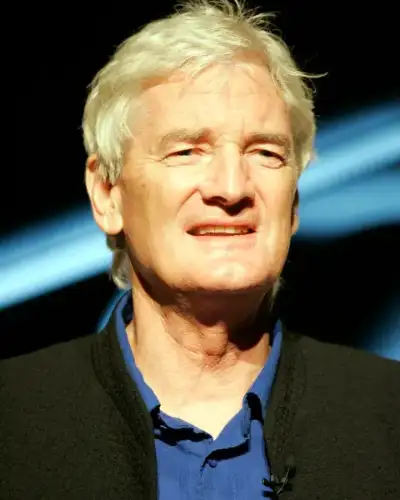
Many people who buy the Product Launch Formula are perfectionists. They want the course, the slides and the sales page to be flawless before anyone sees them. James Dyson’s story is about the opposite: the willingness to make thousands of imperfect versions until one works.
Today the Dyson name is on vacuum cleaners, hair dryers and fans around the world. Behind it is a five-year stretch of failure that would have broken most inventors — and an industry that refused to sell the result.
Chapter 1James Dyson’s early loss and first invention
James Dyson was born in 1947 in Norfolk, England. When he was nine, his father died of cancer.
He studied design and engineering. His first original product was the Ballbarrow — a wheelbarrow with a ball instead of a wheel, so it wouldn’t sink into soft ground. It was clever enough to be featured on the BBC’s Tomorrow’s World.
Then, in the late 1970s, he got annoyed at a household appliance.
Chapter 2The Dyson idea: a vacuum that lost suction
Dyson’s Hoover Junior kept losing suction. The reason: the pores of the dust bag clogged with fine dust, and the machine choked. Dyson had seen industrial cyclones — machines that spin air so fast that dust is thrown out of it. Why not build a vacuum that used a cyclone and needed no bag at all?
It was a simple idea. Making it work was not.
Chapter 3James Dyson’s 5,127 prototypes
For the next five years Dyson built prototypes. One after another. Change one thing, test it, fail, change again. In his own words: “I made about 5,127 prototypes of my vacuum before I got it right.”
Five thousand one hundred and twenty-seven. If he built one prototype a day, every day, that would be fourteen years. He did it in five.
The project was partly supported by his wife’s salary as an art teacher. Imagine the dinner-table conversations. Imagine prototype number 3,000.
Each failed prototype told him one thing that didn’t work. After 5,126 of those lessons, he had a vacuum that did.Chapter 4
The industry that said no to James Dyson
Finally he had a machine that worked. Now came the second wall: nobody in Britain would sell it.
No UK manufacturer or distributor would take on his bagless vacuum. The reason was business, not engineering: replacement dust bags were a profitable market, and a vacuum without bags threatened it.
So Dyson went somewhere else. In 1983 his G-Force cleaner was launched in Japan through catalogue sales. It sold for the equivalent of about $2,000 and in 1991 won the International Design Fair prize in Japan. In North America he licensed the technology to another company.
Chapter 5James Dyson builds his own company
The licensing money gave him something he had never had: funds. Since established manufacturers wouldn’t make his vacuum in Britain, he set up his own company, Dyson Ltd. In June 1993 he opened a research center and factory in Malmesbury, Wiltshire.
The Dyson Dual Cyclone became the fastest-selling vacuum cleaner ever made in the UK.
And the company that had inspired his frustration? In 1999 Dyson sued Hoover UK for patent infringement. The High Court ruled that Hoover had deliberately copied a fundamental part of his design. Hoover agreed to pay £4 million in damages.
What James Dyson’s story teaches about launching a product
James Dyson lesson 1: launch, learn, improve
Dyson didn’t get it right on the first try, or the hundredth, or the thousandth. Most launchers expect their first launch to be perfect. Jeff Walker’s Product Launch Formula treats launches as a sequence: every launch teaches you something about your audience, your offer and your messaging, and the next one is better.
James Dyson lesson 2: a small first version is a prototype, not a verdict
A first course with ten students is a prototype. A first webinar with five live viewers is a prototype. Their job is to show you what to fix. Our Product Launch Formula steps guide shows where in a launch you collect that feedback — and how to use it.
James Dyson lesson 3: when the gatekeepers say no, go direct
The British industry wouldn’t sell his product, so Dyson found another market and eventually sold directly through his own company. Online launches are, in a sense, the ultimate “go direct” strategy: you don’t need a publisher, a retailer or a network’s approval. You need an audience and a way to reach it.
James Dyson lesson 4: design the thing people actually want
The bagless vacuum solved a real, everyday frustration. The best launches start the same way: not with “what can I sell?” but with “what is frustrating my audience?” — collected in surveys and conversations before you build anything.
The prototype where James Dyson could have quit
Pick any number between 1 and 5,126. At each one, he had a perfectly good reason to stop: money, time, a family, a working day job. The lesson isn’t that you need 5,127 attempts. It’s that the attempt that works usually comes after the one where most people stop.
James Dyson has no connection to Jeff Walker, Product Launch Formula or PLF Reviews. We tell his story for the lesson. If you’re stuck polishing version one, ship it — and while you do, register free for the Launch Masterclass.
References: where this story is documented
Every fact in this story was checked against the sources below. Quotes are short and attributed; dates and figures follow these references.

Marciano reviews Jeff Walker's public training, the book Launch and the official program pages, and keeps these guides updated. PLF Reviews is an independent affiliate site — not Jeff Walker or Internet Alchemy, Inc. How we review · Affiliate disclosure
Last updated October 11, 2026